Visual perceptual skills are such an ingrained part of everything we do! From reading and writing in learning to finding a missing toy in the playroom, visual perception is involved in so many functional tasks and activities! Many times, occupational therapists work on visual perception through play while working on other skills in therapy.
Visual Perceptual Skills
Below, you will find visual perception information including a collection of strategies that work on each sub-area of visual perception. You will find this information on visual perceptual skills that can be used to address problem areas as well as activities to improve perceptual skills while addressing other areas such as visual motor integration, eye-hand coordination, and motor skills.
Everyone knows someone who has perfect vision, but can not see. There’s the friend who can not locate the ketchup in the fridge, the one who misses every exit when driving, or the sad person who can not see the dolphin, no matter how many times you point to it. The person who can not SEE something, might be struggling with visual perception.
Visual perception is complex. In this post, visual perception will be unraveled, in order to truly understand why your friend can not find matching socks to wear.
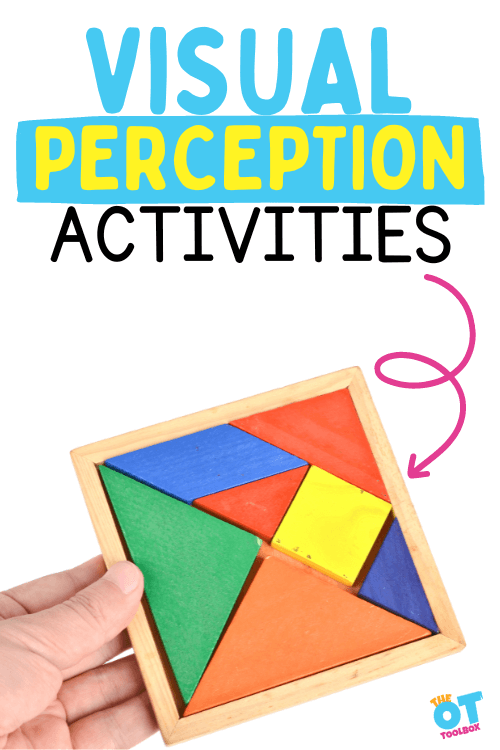
WHAT IS VISUAL PERCEPTION?
In order to understand it, let’s break down the definition of visual perception.
A quick definition of visual perceptual skills: Perceiving and understanding vision from the visual system.
The term visual perception can be broken down into its two words, vision and perception.
Vision is defined as what is seen. It is also described as the ability to “see” something that is not actually visible, as in foresight or mental acuteness. This post is focusing on visual perception, therefore, the first definition, the ability to see, is a better fit.
Perception is the ability to make sense of what is seen. A person can have 20/20 vision, but have poor perceptual skills. Perception not only involves the eyes, but the other senses (movement, hearing, touch, smell, balance).
Visual perceptual skills are those skills needed to help us make sense of what we see. Visual perceptual skills are essential for everything from navigating our world to reading, writing, and manipulating items. Visual perception is made up of a complex combination of various skills. These visual perceptual skills are necessary together and in coordination with one another in order for use to see information and use that visual information to create responses or react with functional abilities like movement or processing.
Why Visual Perceptual Skills are Covered in OT:
Visual perceptual skills play an important role in handwriting, including letter formation, copying words and letters, spatial awareness, left-to-right orientation, organization on a page, line use, and size awareness. You can see how vision impacts learning and completion of written work, math, and even reading comprehension. Much of a school day’s tasks revolves around visual perceptual skills.
If you learner has trouble seeing, a visit to an ophthalmologist would be recommended first.
Visual perception is important for many different school tasks including reading, writing, cutting, copying from the board, puzzles, locating objects, navigating the playground, and eye-hand coordination. Treatment includes training the brain to SEE, through repetition, practice, coaching, and exercises.
EIGHT Types OF VISUAL PERCEPTION
Visual perception can be broken down into eight sub areas. The types of visual perception include;
- Visual Attention: The ability to focus on important visual information and filter out unimportant background information
- Visual Discrimination: The ability to determine differences or similarities in objects based on size, color, shape, etc.
- Visual Memory: The ability to recall visual traits of a form or object
- Visual Spatial Relationships: Understanding the relationships of objects within the environment
- Visual Sequential-Memory: The ability to recall a sequence of objects in the correct order
- Visual Figure Ground: The ability to locate something in a busy background
- Visual Form Constancy: The ability to know that a form or shape is the same, even if it has been made smaller/larger or has been turned around
- Visual Closure: The ability to recognize a form or object when part of the picture is missing
Visual perception requires oculomotor control and the eye’s ability to move in fields of vision, converge, fixate, track, and scan. Accordingly, visual perception falls under the umbrella of “visual processing”.
Also under that large umbrella of visual processing, you will find “visual motor integration”.
Visual motor skills involve the eye’s ability to retrieve information (through oculomotor skills) and the brain’s ability to perceive and process that information). This integration allows us to in return, produce motor output.
Therefore, visual motor integration permits one’s ability to form letters or numbers appropriately when writing, copy shapes, copy a list of homework assignments, completing puzzles, or complete other visual and motor tasks.
Additionally, there is an eye-hand component. This eye-hand coordination is often times, referred to as visual motor integration. However, eye-hand coordination can indicate those activities that require motor output in the form of positioning items in a specific place such as using tongs to pick up an item, catching a ball, or putting an object into a target. They require placement and positioning of the hand (or other body parts), incorporating components such as sensory processing, core stability, strength and endurance, positioning, balance, and the visual skill of depth perception.
Eye-hand coordination develops from a very young age…built on the foundation of visual processing!
Visual Perception Disorders
Visual perceptual disorders can be caused by several things. This might include muscle imbalance in the eyes, damage to optic nerves III, IV, or VI, or dysfunction in areas of the brain.
Strabismus is one visual perceptual disorder that occurs when muscle imbalance of the extraocular muscles of the eyes cause one eye to deviate from the equal positioning of the other eye. This shows up in a child as one eye failing to converge with the other. Check out our resource on visual convergence for more information on this.
Another way we can look at visual perceptual disorders is by looking at the learning difficulties that some kids have. There may be a disconnect between the areas of the brain that interferes with processing and the use of the visual input.
Let’s take a detailed look at visual perceptual skills by looking at each sub-area.
Visual Attention
Visual attention is the ability to attend to visual information, while filtering out unnecessary details. This would include being able to walk in a hallway while filtering out the people passing by, picking a person out of a crowd, reading, driving a car, or finding a certain pair of socks in a drawer.
Visual Attention- This visual perceptual skill allows us to focus on the important pieces or parts of what we see. When we “take in” a scene or image in front of us, we are able to filter out the unimportant information. In this way, a student is able to focus our eyes on the teacher when she teaches. Driving down a road requires visual attention to take in the road so we can drive safely. Visual attention is important in copy work as students copy information from a Smart Board or book onto a piece of paper. As they visually scan from one point to another, they attend to the place they left off. Visual attention is also important and very needed in reading.
Visual attention is the ability to focus on visual information, sustain focus over time, and shift attention when needed. It plays an important role in reading, handwriting, classroom learning, and everyday activities. Here are examples of tasks that require visual attention:
- Copying words from the board to paper
- Finding a specific word on a worksheet
- Locating a backpack in a busy classroom cubby area
- Following a teacher’s demonstration on the board
- Completing a word search puzzle
- Tracking a line of text while reading
- Finding a specific toy in a toy bin
- Matching pictures in a memory game
- Sorting objects by color or shape
- Locating numbers in a math worksheet
- Following visual directions in a craft activity
- Searching for items on a scavenger hunt
- Identifying differences in “spot the difference” pictures
- Playing matching card games
- Copying shapes or designs from a model
- Watching a ball during catch or sports play
- Completing connect-the-dot pictures
- Identifying letters in a busy page of text
- Finding a specific icon on a computer screen or tablet
- Locating materials on a crowded desk
Red flags for visual attention deficits:
- Bumping into things when walking
- Not being able to find items
- Difficulty with writing, reading letters and numbers, or recognizing the difference in shapes/letters/numbers
- Inefficient or incorrect copying from a board or another paper
- Inability to follow directions when walking or driving
- Difficulty identifying an object when only parts of it can be seen
- Trouble locating a specific image when the image is surrounded by other images
- Fatigue when doing work that requires visual attention
- Frequent headaches, blurry vision
- Reluctance or refusal to complete school work
- Social difficulties related to reading facial expressions, not attending to others in a group, or difficulty looking at the correct person/item
Activities to work on visual attention skills include:
- Mazes
- Card games
- Memory
- Spot It games
- Slam game
- I Spy games and worksheets
- Puzzles
- Rush Hour game
- Blokus game
- Quirkle game
- Connect Four game
- Checkers
- Guess Who game
- Tangram activities
Occupational Therapy Intervention Strategies to Improve Visual Attention
These strategies help children sustain focus on visual information, filter distractions, and improve attention to visual details. You can use some of these ideas in OT sessions. Some of the ideas in the list below are modifications or adaptations to the environment that make visual attention skills easier and others are ways to strengthen this skill. Of course, this is not an exhaustive list of ideas. You can modify or work on these skills in many other ways, based on the individual’s needs or specific circumstances.
- Reduce visual clutter- Simplify worksheets, desks, and workspaces to decrease competing visual information.
- Highlight key information- Use highlighters, colored boxes, or bold markers to draw attention to important visual details.
- Use visual boundaries- Provide reading strips, index cards, or paper windows to help isolate lines of text.
- Practice visual scanning games- Use word searches, I Spy games, and scavenger hunts to strengthen visual search and attention.
- Limit distractions in the workspace- Seat the student away from busy bulletin boards, windows, or high-traffic areas.
- Provide visual cues- Use arrows, circles, or stickers to direct the student’s eyes to the correct place.
- Use short visual tasks first- Start with small amounts of visual information before gradually increasing complexity.
- Incorporate movement breaks- Movement helps regulate attention and can improve focus during seated visual tasks.
- Use multi-sensory learning- Combine visual information with touch or movement (tracing letters, building words with tiles).
- Teach visual scanning patterns- Encourage left-to-right scanning patterns used in reading and writing tasks.
- Play visual memory games- Card matching, memory games, and pattern recall activities support visual attention and memory.
- Use visual timers or checklists- Provide visual structure to help students maintain focus on tasks.
- Practice copying tasks gradually- Begin with simple shapes and increase to more complex designs or writing.
- Use technology-based visual games- Interactive visual attention apps or computer activities can motivate practice.
- Build attention endurance- Gradually increase the length of time required to complete visual tasks.
Visual Discrimination
Visual Discrimination is the ability to determine differences or similarities in objects based on size, color, shape, etc. It involves being able to sort, categorize, and notice subtle differences in objects.
Visual Discrimination– This visual perception skill enables us to determine slight differences in objects. In hidden picture activities, this skill is needed to determine and locate different hidden objects. When writing and reading, visual discrimination allows us to perceive the difference between “p” and “d”. Puzzles including ones like the wooden letter puzzle described below address visual discrimination. There are many puzzles on the market that meet different age and grade levels. Here are a (Amazon affiliate link) variety of puzzles to consider.
Visual discrimination is the ability to notice similarities and differences between visual information such as shapes, letters, numbers, objects, and patterns. This skill is essential for reading, writing, math, and everyday tasks that require identifying details.
- Telling the difference between similar letters such as b, d, p, and q
- Distinguishing m from n or u from v in handwriting
- Identifying the correct word in a sentence when words look similar
- Recognizing the difference between 6 and 9 or 3 and 8
- Sorting objects by shape or size
- Finding the correct puzzle piece that fits a space
- Matching identical pictures in a memory game
- Identifying the correct symbol in math problems
- Recognizing uppercase and lowercase letters
- Matching socks or clothing items by pattern or color
- Choosing the correct tool from similar-looking objects
- Spotting differences in “find the difference” pictures
- Identifying the correct spelling of a word when options are similar
- Recognizing subtle differences in shapes in geometry activities
- Sorting coins by type
- Matching letters during early reading activities
- Finding the correct icon on a computer or tablet screen
- Identifying objects that look similar in a busy picture
- Recognizing subtle differences between two nearly identical drawings
- Sorting small toys or manipulatives that look similar but have small differences
Red Flags for Visual Discrimination – Learner has difficulty:
- sorting similar items such as coins, socks, silverware, especially those with subtle differences
- effectively read maps
- reading words that are similar such as “cat” and “cap”
- completing puzzles or spot the difference pages
As always, Amazon is full of (affiliate link) resources for visual discrimination.
OT Intervention Strategies for Visual Discrimination
These strategies help children improve their ability to notice visual differences and identify important visual details.
- Use matching games- Memory cards, matching pictures, or matching letters strengthen visual discrimination.
- Play “spot the difference” activities- Children compare two pictures and identify small visual differences.
- Sorting activities- Sort objects by shape, size, color, or pattern to improve visual comparison skills.
- Use puzzles- Puzzles require children to identify small differences between shapes and pieces.
- Letter and number discrimination activities- Practice identifying commonly confused letters such as b/d/p/q.
- Visual search games- Activities like I Spy or scavenger hunts strengthen noticing visual details.
- Pattern copying tasks- Copy block patterns or bead patterns to encourage attention to visual differences.
- Use highlighting strategies- Highlight or circle differences in worksheets to direct attention to key details.
- Work with shape-building activities- Use tangrams, pattern blocks, or geometric puzzles.
- Play card games- Games like Uno, Go Fish, or matching cards require visual comparison.
- Practice word discrimination- Provide lists of similar-looking words and have children identify the correct one.
- Use visual discrimination worksheets- Activities that require circling the correct image among similar options.
- Build with construction toys- Lego or block designs require noticing small differences in shapes and placement.
- Use tracing and copying activities- Tracing shapes or designs helps children focus on visual details.
- Provide multisensory learning opportunities- Combine visual tasks with touch, movement, or manipulation to strengthen recognition.
Some more activity ideas to support development of visual discrimination skills:
- Matching activities
- Memory games
- Sorting by color
- Patterning beads in bracelet making
- “What’s different” pictures
- Sort coins
- Word searches
- Puzzles
- Play “what doesn’t belong” by placing toys or objects on a table and finding one item that is different than the others.
- Look in a writing passage such as in a newspaper and find all of one letter or word
- Tangram activities or pattern block activities
Visual Memory
Visual Memory is the visual skill that allows learners to record, store and retrieve information. It allows learners to learn and later recall this information. It is referred to as “the mind’s eye”, as the brain learns and stores data. The OT Toolbox has a great post on.
Visual Memory- This is one’s ability to store visual information in short term memory. This skill allows us to recall visual information. When completing hidden picture puzzles, kids visually store images of items they are looking for when scanning to locate a specific shape or image. This skill is necessary for handwriting tasks when copying information from a source, such as lists of words, homework lists, and copying sentences.
Red Flags for Visual Memory – Learner has difficulty:
- Recalling site words
- Spelling – especially remembering how words are spelled
- Reading fluidly – each word the learner reads seems brand new
- Writing – recalling letter formation
- Drawing – remembering what an item is supposed to look like from past experiences
- Math skills – remembering how the problem is supposed to look, graphing, or using a calculator
- Completing life skills such as following a recipe, reading a map, shopping, using the internet, typing
Activities to develop visual memory skills include:
- Card games
- Memory games
- Matching games
- “What’s missing” game- Place objects on a table. Ask the child to memorize the items. Cover them with a towel and remove one items. Then remove the towel and ask the child to name the object that is missing.
- SlapJack
- Spot It games
- I Spy memory, are fun ways to practice visual memory.
- Amazon has a great (affiliate link) list of visual memory games here
Visual Spatial Relationships
Visual spatial relationships are a visual perceptual skill involved in understanding positions of objects in relation to others. Knowing which building is in front of another, understanding how far to stand next to others in line, describing positioning using words (left, right, over, under, behind) are examples.
Laterality and directionality are two common challenges.
Laterality is the ability to tell left and right on oneself. Directionality is being able to tell the difference between right and left on objects or someone else.
Visual Spatial Relationships- This visual perceptual skill allows us to recognize and understand the relationships of objects within the environment and how they relate to one another.
Red Flags for Visual Spatial Relationship delay – Learner has difficulty:
- Knowing their left and right
- Reading similar letters such as b/d p/q without errors
- Forming letters/numbers correctly
- Following directions involving space, such as “go right”
- Moving around their environment without bumping into objects
- Learning social skills involving body language and spatial distance from others
- Copying written work, staying inside the lines, or writing within certain confines
- Completing puzzles – knowing which way to place a piece
Activities to develop visual spatial relationships:
- Body awareness activities
- Obstacle courses
- Tag games
- Hula hoop activities
- Hopscotch
- Building with blocks
- Origami
- Puzzles
- Simon Says activities
- Direction following games
- Orientation games
- Scavenger hunt activities
The OT Toolbox has a great post on Visual Spatial Relationships here.
Visual Sequential Memory
This is visual memory PLUS. Visual sequential memory involves recalling objects seen in a certain order. This is important for remembering math problems, reading fluidly, recalling phone numbers, or following multi-step directions.
Visual Sequential Memory- This visual perceptual skill is the ability to visually take in and then later recall the sequence or order of items in the correct order. This skill is important in reading and writing. Visual sequential memory is important in spelling words correctly and recognizing that words are not spelled correctly.
Red Flags for Visual Sequential Memory problems –
- Difficulty with spelling, math concepts
- Slow copying from the board – has difficulty remembering a sequence of digits
- Unable to remember large blocks of information such as phone numbers, addresses, and dates
- Problems mastering higher level learning concepts such as alphabetizing, large math problems, following detailed multi-step directions, remembering a list of items in order
The OT Toolbox has a fabulous Visual Processing Bundle Deal to address not only visual sequential memory, but other visual processing skills.
Activities to develop visual sequential memory include:
- Simon game
- Mastermind game
- Sequencing activities
- Pattern beads to make bracelets and necklaces
- Simon says commands in an order
- Sequence activities such as hygiene, self-care, dressing tasks, etc.
- Alphabetical order activities
Visual Figure Ground
Figure ground is the ability to pick out objects in a competing background. It involves looking at something, and being able to recognize the part, or object you are looking for. It is how you find the ketchup in the fridge, a certain pair of socks in a drawer, the right page in a folder, picking out an object on a page, or following a map.
Visual Figure-Ground– This skill enables us to locate items in a busy background. Finding hidden items in a hidden pictures puzzle works on this skill by visually scanning and identifying items within a busy scene. In handwriting, visual figure ground is necessary for copying written work from a model and locating the place left off when shifting vision.
Red flags for difficulty with figure ground
- Difficulty locating objects in competing environments such as a drawer, folder, crowd
- Loses their place when reading, copying from the board, writing from a model
- Struggles to find personal items in a crowded space
- Slow to complete work
- Unable to effectively sort items from a large pile
Check out this post and FREEBIE on visual scanning from the OT Toolbox
Children need adequate visual figure ground perceptual skills to function properly in school and at home. If
you have concerns about your child’s visual skills, be sure to start out by having your child undergo a
thorough vision examination by an optometrist or an ophthalmologist (medical doctor). If your child is having
trouble with figure ground skills try to reduce extraneous visual stimuli, teach organizational skills, use
highlighters to emphasize important points or cover up parts of worksheets to only show the material that
needs to be completed.
Some activity ideas to develop visual figure ground perceptual skills include:
- I Spy games
- Sorting activities
- Hidden picture activities
- Memory games
- Matching games
- Color by number sheets
- Word searches
- Puzzles
- Shape sorting toys
Visual Form Constancy
Visual form constancy is the ability to know that a form or shape is the same, even if it has been made smaller/larger or has been turned around. It is very difficult to learn to read handwriting that may vary, sort items that are similar but not the same, or generalize from one page to the next.
Form Constancy– This skill allows us to visually recognize objects no matter their orientation. When completing a hidden picture puzzle, children can recognize the missing object whether it is upside down or sideways. In handwriting skills, we use this ability to read and know letters and numbers no matter which direction we see them.
Red flags:
- Difficulty completing worksheets/puzzles, sorting items that are slightly different
- Slow or delayed learning to read, especially with different fonts, or writing styles
- Unable to effectively read other people’s handwriting
Activities to develop form constancy skills:
- Puzzles
- Sort objects such as coins
- Scavenger hunts around the neighborhood
- Look for certain letters on signs while driving around in a car
- License plate games
- Matching activities
- “What’s different” sheets
Visual Closure
Visual closure is the ability to determine what an object is when only part of it is visible. This would include puzzles, dot to dots, and identifying an object when part of it is obscured.
Visual Closure– This visual perceptual skill allows us to see part of an object and visualize in our “mind’s eye” to determine the whole object. When we see part of an item we use visual closure to know what the whole item is. This skill requires the cognitive process of problem solving to identify items. Visual Closure is used to locate and recognize items in a hidden picture puzzle. In written work, we use visual closure to recognize parts of words and letters when reading and copying work.
Visual closure Red flags would include:
- Difficulty completing puzzles/
- Challenges with dot to dot pages
- Refusal to engage in these types of tasks
- Slow reading fluency.
The OT Toolbox has a Visual Closure Workbook and Match-up activity available for download.
Activities to develop visual closure skills include:
- Hiding objects under a towel and partially uncovering the objects. As the child to determine the object.
- Organize a messy drawer
- Find matching socks in a laundry basket
- Dot to dot pictures
- Puzzles
Visual Perception Tests
- Motor Free Visual Perception Test (MVPT)– overall visual perception screening tool
- Test of Visual Perceptual Skills – breaks down skills into categories
- The Developmental Test of Visual Perception – thorough test of skills
- Test of Visual Motor Skills/Perception – a general screener to assess basic skills. Not a great test of different sub categories.
Amazon has a nice list of (affiliate links) visual perception tests in one place. Of course you can order these from other sources, this is just a convenient list.
Supporting Different types of visual perception
These skills are so very much needed for learning, reading, handwriting, play, and just about every functional task we perform.
There are ways to address the areas that make up visual perceptual skills. You will find many of these activities listed on our visual motor skills page. For more, check out the fun ideas listed below:
- When working on visual perception, be sure to take into account any visual motor delays. Try activities that only involve looking, not writing as well. This will give you a better picture of your learner’s abilities
- Several games/activities will work on multiple skills. This is fine, however, a test is helpful to determine which skill areas are below average to better tailor your treatment
- This can be a long frustrating process. Provide compensation strategies in the meantime to help decrease frustration and improve skill level.
The OT Toolbox is FULL of posts and resources to help understand and improve visual perception. This is just a partial list:
- Toys and Tools to Improve Visual Perception– Work on the skills needed for reading, writing, and learning through play!
- Visual Perception and Handwriting
- Use Tangrams to Improve Visual Perception in Handwriting
- Improve Visual Perception with Markers
- Use Tangrams to Improve Visual Perception – In fact, you don’t need a tangram set to gain the benefit of improving visual perception. Make your own tangrams using a sponge! And then build to work on form constancy, visual discrimination, visual spatial relations, figure-ground, and more. You can even get them wet and stick them to a window or shower wall!
- Space Visual Perception Puzzle – Print and use this with hands-on play
- Flower Visual Perception Printable
- Hidden pictures are a great way to work on skills like figure-ground, visual attention, and visual discrimination. Use the book, Wacky Wednesday to work on visual perceptual skills like these.
- Make your own visual perception worksheets (with hands-on fine motor work!) like these apple themed visual perception sheets.
- Use blocks and fun shapes to work on visual perceptual skills through play. This cork block activity were a fun way to work on many visual skills.
- Spacing puzzles in handwriting activities are a fun way to work on the visual perceptual skills needed for spacing between letters and words, visual discrimination, visual closure, and orthographic memory. This is a much needed skill for spelling patterns and knowing if a work is spelled correctly.
- These Spring Themed Visual Perception activities focus on the warmer weather and getting outdoors while working on the visual perceptual skills needed for so many areas.
- Visual attention and visual memory plays a part in visual spatial relations and spatial awareness. These tips and tricks for spatial awareness will help with handwriting legibility.
- Use plain old markers to work on visual perceptual skills! Here are five fun ways to use those markers in your therapy bag in creative ways.
- Do you know Elmer from the popular children’s books? Make an Elmer using craft foam sheets and work on visual perceptual skills through play like we did in this Elmer activity!
- Working on handwriting? Try adding a bold or highlighted line to improve spatial relations in written work. Here are more ways to improve visual spatial awareness in handwriting.
Visual Perception FAQ
When I work with parents and teachers of kids or students who struggle with visual perception, I tend to get a lot of questions. Here are some of the most common questions I get as an OT, and how I answer them.
What are visual perceptual skills?
Visual perceptual skills are the brain’s ability to interpret and make sense of what the eyes see. These skills allow children to recognize shapes, letters, numbers, patterns, and objects and understand how they relate to one another. Visual perception goes beyond eyesight. A child may have normal vision but still struggle with visual perceptual skills if the brain has difficulty processing visual information.
These skills are important for many everyday tasks such as reading, handwriting, math, puzzles, sports, and navigating the environment.
Why are visual perceptual skills important?
Visual perceptual skills help children interact with their environment and complete school tasks successfully. These skills allow children to identify letters and numbers, copy from the board, find items on a busy worksheet, and recognize patterns and differences.
Strong visual perceptual abilities support learning, problem solving, and independence in both academic and daily activities.
What are the main visual perceptual skills?
Most occupational therapists describe several key visual perceptual skills that work together to help the brain interpret visual information. These include:
- Visual discrimination
- Visual memory
- Visual spatial relations
- Visual form constancy
- Visual sequential memory
- Visual figure-ground
- Visual closure
Each of these skills contributes to reading, writing, problem solving, and everyday visual tasks.
What is an example of visual perception?
Visual perception is used any time a child interprets visual information. For example, a child uses visual discrimination to tell the difference between letters like b and d, visual memory to remember the spelling of a word, and visual figure-ground skills to find a specific object in a cluttered space.
Completing puzzles, copying shapes, finding items in a search game, or recognizing familiar objects are all examples of visual perception in action.
What does poor visual perception mean?
Poor visual perception means the brain has difficulty organizing or interpreting visual information. Children with visual perceptual challenges may struggle with tasks such as copying from the board, recognizing similar letters or numbers, completing puzzles, or finding objects in busy environments.
These challenges can affect school performance, handwriting, reading development, and daily activities that rely on visual information.
Can visual perceptual skills be improved?
Yes. Visual perceptual skills can be strengthened through practice and targeted activities. Occupational therapy often uses games and structured tasks that encourage children to compare shapes, identify patterns, remember visual information, and search for objects within complex backgrounds.
Activities such as puzzles, matching games, pattern building, visual scanning games, and drawing tasks can help children develop stronger visual perceptual abilities.
How are visual perceptual skills assessed?
Visual perceptual skills are typically assessed by occupational therapists or other professionals using standardized tests and clinical observations. These assessments examine how a child interprets visual information, copies shapes, identifies patterns, and remembers visual details.
Therapists also look at how visual perceptual skills affect functional tasks such as reading, handwriting, cutting, and classroom participation.
What are visual perceptual skills used for?
Visual perceptual skills are used in many everyday activities including:
- Reading and recognizing letters
- Handwriting and copying work
- Solving math problems
- Completing puzzles
- Finding objects in a busy space
- Navigating environments
- Participating in sports and play
These skills allow children to process visual information quickly and accurately so they can interact effectively with their surroundings.
What are examples of visual perception activities?
Activities that support visual perception include puzzles, matching games, word searches, building patterns with blocks, copying shapes or designs, sorting objects by shape or color, and “I Spy” search games. These types of tasks strengthen the brain’s ability to interpret and organize visual information.